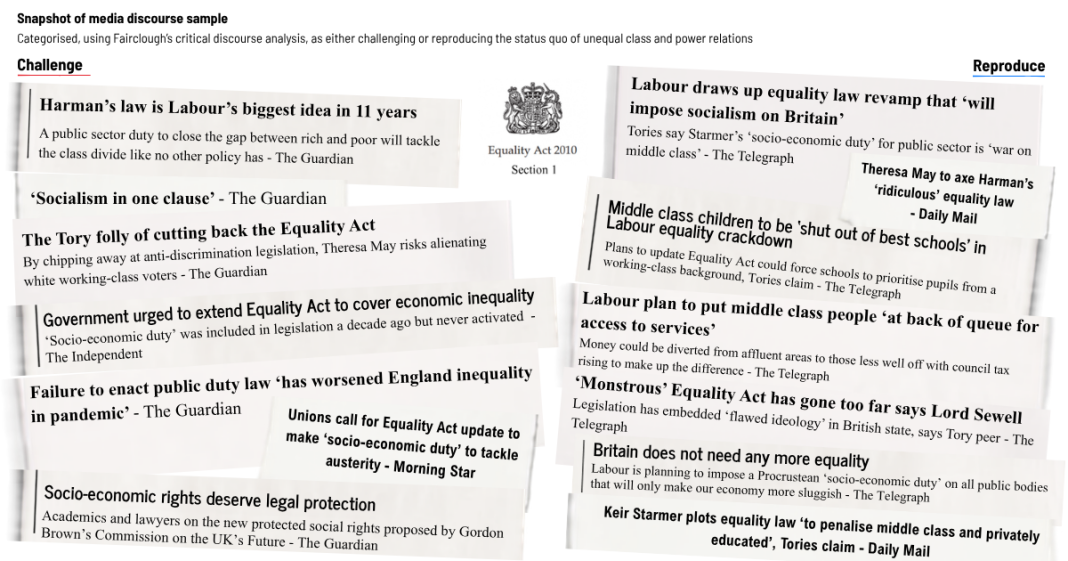
I mean it isn't at all surprising; when inequalities - and measures designed to tackle extreme inequality - enter the conversation, the neoliberal word-bingo begins. Cries of bureaucracy, state interference and free-market meritocracy (myths) are swiftly bandied about with alarming repetition from multiple mouths. It’s almost as if there was a memo to brief some folks on how to talk about it.
But, my friends, there is once again something larger at play, and it tells us a great deal about the debate unfolding as the UK government prepares to bring the long-awaited Section 1 of the Equality Act 2010 (the socio-economic duty) into force.
Before we get there though, let's just remind ourselves what the SED actually is, because facts and all that.
The purpose of this duty is pretty straightforward: it asks decision-makers to consider how their strategic choices - such as policy, public spending, commissioning or de-commissioning of services - might affect people experiencing poverty and socio-economic disadvantage. Where it has been activated in Scotland and Wales, and voluntarily as good practice in parts of England, it has delivered success stories. Yet, instead of seeing this as a positive measure to make decision-making more inclusive and responsive to inequality, we are seeing an increasingly heated debate that is often disconnected from what the duty is actually about.
Our latest research, produced in collaboration with the University of York Law School, examines how the duty is being discussed across politics, media, academia and public life, revealing the competing narratives: who is saying what, whose voices are amplified or excluded, and what this tells us. The findings raise questions beyond analysing the policy itself; we find ourselves asking who gets to shape the public conversation about inequality.
The analysis found that most of the loudest objections came from a small number of powerful media outlets owned by some of the wealthiest people. Same old story, again. We already know that money buys access and influence, which in turn uses that influence to secure even more power, and power shapes the rules that self serve. It is all here in our Money, Media and Lords report.
And this matters. Because the way we describe inequality directly shapes what we believe can be done about it. When poverty is presented as a consequence of individual choices and inadequacy, structural solutions look unnecessary. You only have to look at the debate around young people not in education, employment or training - the so-called NEET crisis - to see how structural problems can be misrepresented as individual failings.
Likewise, when measures designed to reduce inequality and policy-inflicted harms are branded as ‘ideological dross’, or an ‘equality crackdown’, even modest attempts to change how public money and services are allocated can be made to seem extreme.
Unnervingly, this billionaire-owned media influence on public opinion can affect the political feasibility of steps to raise living standards and screen out policies that make our lives worse.
Our research is ultimately about something bigger. At its heart is a question about power: are platforms being used to inform the public—or to undermine a democratically approved duty designed to disrupt the structural inequality that favours the few. Read the full blog here, or tell us what you think, below. |